
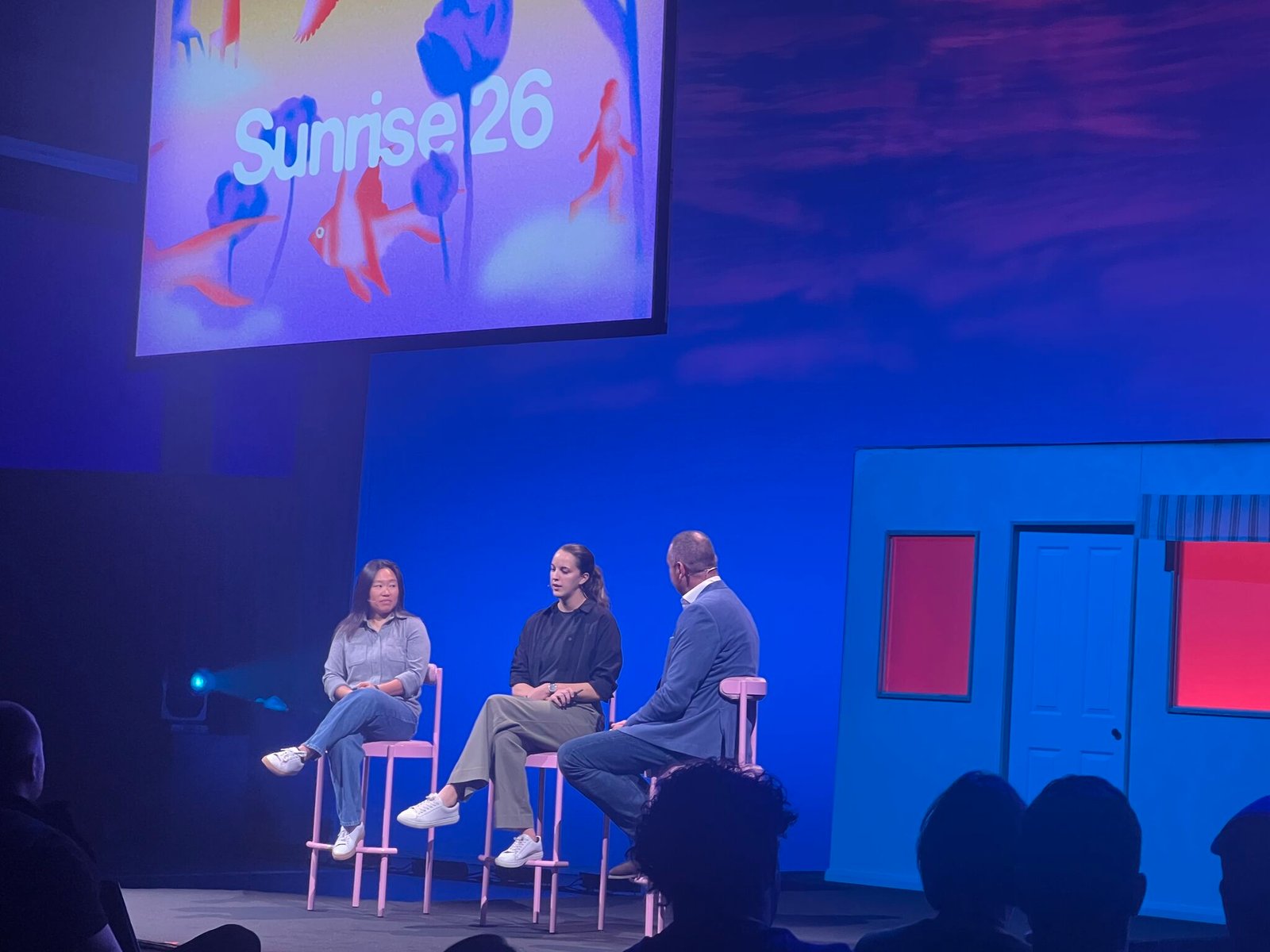
I was at the Sunrise Startup Festival last Thursday, and one of the more interesting sessions was the opening keynote and panel by Anthropic, who recently opened their Sydney office. Angela Jiang, Head of Product for the Claude Platform, and Katelyn Lesse, Head of Platform Engineering, were the ones on stage.
Australia was an interesting market for Anthropic to plant their flag in, and sending their Head of Product and Head of Platform Engineering to a startup festival here says something. Their reasoning was pretty clear; we rank among the highest users of Claude on a per capita basis in the world, and they wanted to come and see first hand what the local market was actually doing with it.
While there was plenty of product vision in the talk, what I kept coming back to afterwards was the commentary about how Anthropic actually operates internally. It’s rare to get a genuine look inside one of the leading AI labs, so I thought it was worth pulling that thread a little.
Team size hasn’t changed; composition has.
Teams at Anthropic still sit at around seven or eight people. By their own admission, that’s not really driven by any scientific reasoning; it’s more cultural and historical, and it just seems to be the size that works. Anyone who has spent time building or running technology teams will probably nod at that.
What has changed meaningfully is what those eight people actually look like. The old model, one team lead, one product manager, and four to six individual contributors, is giving way to something different. The new shape is one Team Lead and closer to a 50/50 split between what they’re calling System Designers and Implementers. What wasn’t entirely clear from the talk was whether the System Designer role is a purely technical one, a senior engineer with architectural responsibility, or whether it absorbs what product management used to do. My instinct is that it’s probably a blend.
What was made explicit by Angela is that PMs need to be more technical now. Not engineers exactly, but technical enough to ship simple features themselves. That’s a real shift. If you’re a product manager who has been leaning on engineering capacity to execute your ideas, that dynamic is changing.
The innovation cycle is being compressed deliberately.
One of the more striking things Angela also spoke about was the deliberate effort to collapse the time between idea and shipped feature. The expectation used to be that a feature takes a month. The goal now is to genuinely explore how to get it done in a day.
Some of that compression comes from better planning and faster iteration. But a lot of it, and they were reasonably candid about this, comes from handing large parts of the implementation effort directly to Claude. One-shotting feature development, where you prompt Claude with enough context and it produces something close to shippable code, is clearly becoming a meaningful part of how their teams actually work.
Agents are the next frontier internally, not just in the product.
There was mention that Claude agents are getting significantly closer to being self-learning, improving at operating autonomously for much longer periods without needing a human in the loop. This isn’t just a product pitch; the implication was that Anthropic is exploring what that looks like for their own internal workflows too.
The framing they used was around systems that run 24/7, monitoring and responding without waiting for a human operator to wake up and make a call. As an example they used a Great Barrier Reef monitoring system, which is admittedly a more compelling illustration than a software deployment pipeline, but the underlying point applies equally well to the latter.
What this means if you’re not Anthropic.
The honest takeaway from all of this is that the productivity gains they’re describing are real, but they require genuine structural change to realise. You don’t get a month’s worth of feature development into a day just by giving your existing team access to Claude. You get it by redesigning how the team is composed, what each role is responsible for, and how much technical fluency you expect across the board.
The shift towards System Designers and away from a traditional PM and TL split is an expression of that. So is the expectation that product people can ship. These aren’t cosmetic changes to job titles; they’re a different theory of how software gets built.
I doubt most technology organisation are even starting to have these conversations yet, but based on what was on stage yesterday, the organisations that figure it out first are going to move at a pace that makes the rest look like they’re standing still.
A couple of quick asides.
One piece of advice that landed well was around SaaS pricing. The argument was that platforms need to move away from seat-based models and towards feature-based pricing tied to token usage. The thinking is that AI features are now both the most valuable and the most expensive to serve, and that needs to be reflected in how they’re priced. It’s a sensible point; and probably some advice that more than a few established SaaS companies in Australia (Atlassian/Canva) should be taking seriously.
on Mythos.
In the Q&A part of the panel, someone in the audience asked whether Anthropic’s newest model, Mythos, is genuinely as capable as the reports suggest, or whether it’s mostly well-managed hype. It was the most interesting moment of the session, not because of the answer, but because of the reaction before the answer came. Katelyn paused in the way people do when they’re trying to find language for something they haven’t quite been able to articulate even to themselves. I’m reasonably good at reading people in those moments; and my strong impression was that this is not a incremental improvement dressed up as a leap. It genuinely seems to be a step change in a different class entirely. Worth keeping a close eye on.
Leave a Reply