
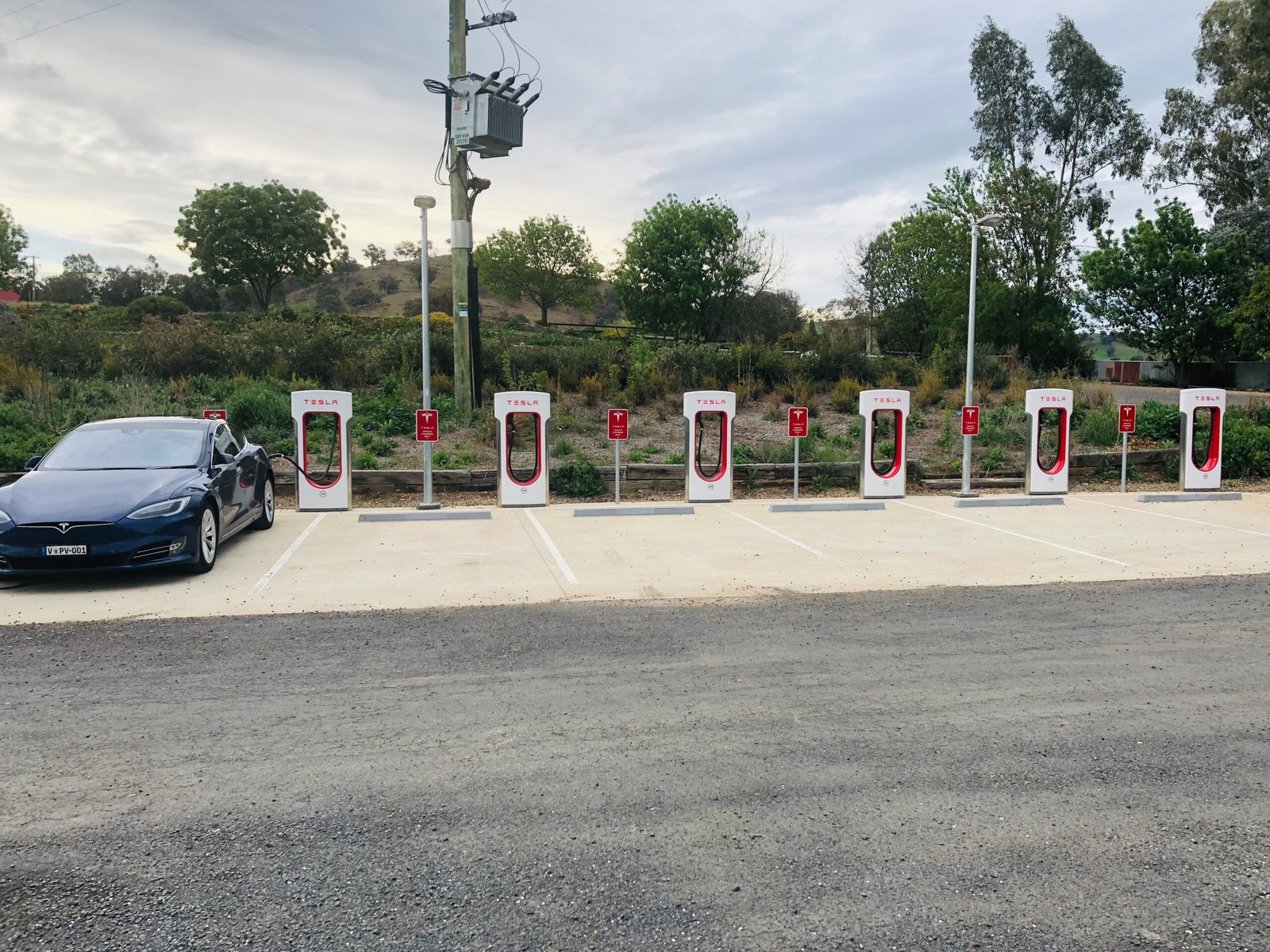
It started in Bairnsdale. We pulled into the Tesla Supercharger to find every bay full; frustrating, but not unusual, and we were next in line so it was manageable. Six more Teslas arrive one after another within 10 minutes of our arrival while we were still waiting, a queue forming behind us almost instantly. This immediately created the issue of tracking who was next in line, luckily the Coles carpark was somewhat empty, so each car naturally lined up in each bay one after the other. We were traveling in a convoy with friends so as soon as this situation transpired I did a quick search on Plugshare.com and sent them a text to warn them: skip Bairnsdale, head straight to the NRMA charger at Lakes Entrance where there are 3 of 4 charges available, we’ll meet you there.
Lakes Entrance turned out to be a lovely accident. We found a winery, sat down for lunch, and did what you do on a long weekend away; we relaxed, we lingered, we ordered another glass. It was exactly the kind of unplanned afternoon that makes a road trip worth taking. We stayed longer than we should have. We knew it at the time, in that vague, easy to ignore way you know things when the food and wine is good. We weren’t in a rush it would be fine. Or so we thought…
We arrived at Cann River rain streaking across the windscreen, and noticed quite a few people congregating around the Tesla chargers. We found a spot to park and walked over to discover some general confusion around the order of things. With some gentle encouragement we were able to get everyone to identify themselves and their vehicle and at this point found ourselves number thirteen in the queue with the three Tesla Superchargers already full. I immediately started doing the math in my head. 4 cars per slot, 20-30 minutes per car minimum, plus our time to charge. I passed on the bad news to the family, luckily there was a public toilet and a playground for the kids.

What followed was a couple of hours of standing in the rain, coordinating a makeshift queue system with eleven strangers, watching the weather and collectively hoping nobody had a charging fault. We were lucky. The rain stayed light. The charger held up. Everyone got through, it was even jovial at times as everyone was sharing the same miserable experience. But the whole time, the thought sitting quietly in the back of my mind was: this is not good enough.
Standing there in the rain, I kept thinking back to our early road trips in the Tesla, nearly 10 years ago now, when the network was sparse and the cars were rare and pulling into a Supercharger to find another EV already there was genuinely exciting; you’d wander over, compare notes, talk about where you’d come from and where you were headed. It felt like a club. The infrastructure hadn’t caught up yet, but neither had the demand, and somehow it balanced out. Twelve people in a queue in the rain, coordinating on their phones, is a very different kind of club.

If the rain had increased in intensity it would have become impossible to manage the queue, and perhaps the jovial nature would have changed to something else. Even worse if the charger had failed everyone would have been stranded. With no other charging locations within 150km, on a public holiday, with local accommodation at capacity, it would have either been a boon for tow truck companies or we all would have ended up sleeping in our cars.
“After ten years and more road trips in an EV than I can count, I am moving back to petrol for the car we use to travel in. That is not a sentence I ever expected to write.”
The return trip introduced a different kind of problem entirely. We’d watched enough charging queues by that point to decide we were not going to repeat the experience on the way home. The plan was simple: charge to one hundred percent before leaving, skip every Supercharger on the route back, and rely on the NRMA fast charger at Lakes Entrance as our one stop.
It was a reasonable plan. On paper, it was actually a good plan. What we hadn’t accounted for was what happens when a ten-year-old Tesla meets a brand new NRMA charger and they decide, at the worst possible moment, that they are not going to cooperate. The charge session started. Something went wrong. And when we tried to disconnect the cable, the charge port jammed, not stuck in the inconvenient way, but stuck in the way where you’re standing in a car park in Lakes Entrance gently trying not to make things worse while quietly catastrophising about the 340 kilometres between you and home.
After calls to NRMA, and Tesla which weren’t that much help truth be told, we eventually got it free. Unfortunately we damaged the port in the process, bent, misaligned, just functional enough to let us disengage, but not functional enough to inspire any confidence about what came next. We left Lakes Entrance with 240 kilometres of charge showing on the dash. We had 340 kilometres to cover. The maths was not complicated, and it was not good.
What followed was the kind of drive that rewires you a little. Luckily Tesla shows you the state of every supercharger from within the cars navigation system. Every Tesla Supercharger between Lakes Entrance and Pakenham was full and very busy. We didn’t stop. We couldn’t risk losing the range detouring nor sitting in the car burning energy while waiting in another queue. We drove carefully, on Teslas ‘Range Mode’ , keeping speed down, and trying to get as much aerodynamic assistance by driving behind trucks and SUVs, watching the percentage tick down with the particular focus of someone who has done the arithmetic and knows exactly where it lands. We pulled into Pakenham with four percent battery remaining. Four percent. On a trip where the original plan had been to skip chargers entirely and coast home in comfort.
This was crunch time, could we charge or would we need a tow. We managed, to carefully work the charge port back into a usable state — enough to charge at Pakenham and get home without a tow truck. Phew!! Crisis averted.
This is not how a modern transport network should function. A charging cable that physically jams and cannot be disconnected is not an edge case to be dismissed; it is a hardware failure on critical infrastructure with no fallback. In a regional town, at night, with a car that cannot move, managed is the difference between an inconvenient story and a genuinely dangerous one.
The charger count narrative talks about new installations, about government funding, about progress. What it does not talk about enough is whether those new chargers are being tested against the diversity of vehicles on Australian roads, including vehicles that are five, eight, ten years old, which is the actual fleet that will be pulling in to charge on any given long weekend for the next decade.
I want to be clear about what this piece is, and what it isn’t. It is not an anti-EV rant. I still believe in the technology. I am not switching because EVs are bad; I am switching because the infrastructure required to use one confidently on regional and rural Australian roads is not where it needs to be, and I no longer have the patience to plan trips around that gap.
The infrastructure story we keep being told
The headline numbers sound encouraging. Tesla reached 150 Supercharger sites across Australia as of late March 2026. The federal government has committed significant funding; the Driving the Nation Fund is partnering with NRMA to deliver a national backbone network of over 100 EV charging stations on key highway routes, spaced at an average interval of 150 kilometres. Progress is real, and I do not want to dismiss it.
But 150 kilometres between chargers, as a planning benchmark, assumes everything goes right. It assumes the charger you arrive at is working. It assumes nobody else is already using it. It assumes the weather is fine and your actual range matches your theoretical range. On a public holiday weekend, driving through the kind of regional Victoria terrain between Melbourne and the New South Wales south coast, none of those assumptions holds particularly firm.
The problem isn’t just the number of chargers
EV sales in Australia are currently outpacing charge point installations by more than three to one. That ratio matters enormously in places like Cann River, because you are not just competing with the number of chargers available; you are competing with an ever-growing pool of EV drivers who have all made the same calculation about where to stop on the same long weekend. A single stall in a regional town was never going to scale to meet that demand, and yet here we are.
As more drivers came to rely on public fast charging, reliability and congestion issues became harder to ignore, particularly during holiday travel periods; this has shifted conversations away from charger counts and toward uptime, redundancy, and user experience. That is exactly the right conversation to be having, but it is one the industry should have started having several years ago.
There are hundreds of millions of dollars being spent on chargers using taxpayer money, but there is quite little consideration given to the lifespan and longevity of electric chargers, and to making operators accountable for their own infrastructure. Accountability is the word. A broken charger in the CBD is an inconvenience. A broken charger in Cann River, on a public holiday, with twelve people in the queue and the next option 150 kilometres away, is something closer to a stranding risk.
The routes that work, and the ones that don’t
For city-based drivers who take occasional road trips on the east coast, a pure BEV is entirely manageable. For those whose travel regularly extends into areas where charging infrastructure is sparse, a PHEV reflects the current reality of Australian roads more honestly. That is a measured and honest summary from people who spend a lot of time thinking about this, and it broadly matches my own experience over the past decade.
The Melbourne to Sydney run? Fine. Adelaide? Fine. The network on the major east coast corridors has genuinely improved and, on a regular weekday, the experience is largely seamless. But get off those corridors, head toward the coast, into the hills, down to the south coast of New South Wales, and the picture changes quickly. The gaps that exist in those areas are not just logistical inconveniences; on a public holiday with a full car and children onboard, they are genuine safety considerations.
A decade is a long time to wait
I have been patient. I bought my first EV when the charging network was genuinely sparse and the technology was genuinely limited, and I adapted my travel habits accordingly. I planned meticulously. I left buffers. I turned inconveniences into stories. For a long time, I believed that patience was the right posture; that the infrastructure would catch up, and that early adopters had a role to play in demonstrating demand.
What I did not anticipate is standing in the rain in Cann River in 2026, doing the same mental calculations I was doing in 2016, just with a longer queue.
The Electric Vehicle Council is confident the vast majority of Australia will have access to public EV charging infrastructure before 2030. I hope they are right. But 2030 is four years away, and I am not willing to spend another four long weekends negotiating queues in the rain on the off-chance the charger holds up.
“The technology deserves better infrastructure. Australian EV drivers deserve better infrastructure. And until we have it, I think we need to be honest that the promise of the electric road trip is still, for many routes, exactly that: a promise.”
The transition is coming. The direction of travel is right. But the gap between the narrative and the lived experience of trying to drive from Melbourne to Eden on Good Friday is, right now, very wide; and for families making practical decisions about which car to buy and how to travel, that gap is what matters most.
I will be back in an EV for road trips eventually. But not yet.



Leave a Reply